
Chris Knudson, Laura Sauls and I shared a panel on Climate Finance Justice: International Perspectives on Climate Policy, Social Justice, and Capital at UC Santa Barbara’s annual nearly-carbon neutral climate conference. This year’s theme was Confronting the Climate Crisis with Systemic Alternatives in the Age of the Coronavirus. You can watch our panel below, or click here for more details and discussion.
This conference session grew from a special issue of Climatic Change, with the same title, that Chris and I edited earlier this year. You can find our introduction, where we articulate the importance of climate finance justice, here.
Interview on Pacifica Radio’s Sojourner Truth
I was honored to be interviewed on Pacifica' Radio’s Sojourner Truth with Margaret Prescod about the Alto Mayo REDD+ project in Peru, and environmental & social justice. My first live radio interview! You can listen to the audio below. You can also read a transcript of the interview on REDD-Monitor. Special thanks to the Global Justice Ecology Project.
500 Women Scientists Earth Day Story Hour
In celebration of Earth Day I was invited to share a story at 500 Women Scientists Virtual Story Hour. Here’s my story about how I went to the edge of the Amazon to study forest carbon offsets, but ended up much more interested in a doctor and the medical clinic he was building.
Amazon Fires and the End of REDD+
I wrote a commentary for REDD+Monitor on the fires in the Amazon and what it means for the REDD+ carbon offset mechanism. Here’s an excerpt:
The fires in the Brazilian Amazon are, in part, typical forest ecosystem processes, as some forest experts have shared. But they are also the product of complex political economic forces, led by a money- and power-hungry, anti-Indigenous political regime. We must not overlook the political rhetoric that has provoked violence on this invaluable ecosystem, and the people who depend on it for survival.
Since taking office January 1, Brazilian president Jair Bolsonaro has widely incited anti-indigenous sentiment. He has spoken about the value of the resources in the Amazon, and positioned indigenous and forest dependent communities as obstacles to resource extraction and capital accumulation. He has denied indigenous land tenure claims and encouraged the murder, abuse, and violent displacement of indigenous communities. The fires we see burning are the direct result of Bolsonaro’s encouragement of extractive industries to take what they want; the fires are the primal image of state-sponsored disregard for the culture, ecology, and biodiversity of the Amazon. They are the embodiment of capitalism and fascism run amok.
REDD was designed to incentivize landholders to maintain forests in exchange for payments that eclipsed profits from deforestation and subsequent land uses, like agriculture or grazing. But REDD was never designed to combat widespread state-sanctioned violence. If the people who manage the forests are dead or dispossessed, who is left to protect the land from development and extractivism?
…
As the Amazon fires continue to burn, indigenous communities are brutalized and disenfranchised. Yet the purchasers of REDD carbon credits won’t feel the impact. The mechanism has contingencies and insurance policies to protect against things like leakage (when deforestation is prevented in one place, but occurs in another) and impermanence (things like pest infestation, or… fires). REDD offers indemnity for the financial investment, but not indemnity for the environment. Polluters whose carbon budgets depend on the credits from Amazon REDD projects? They have insurance policies to cover their loss.
Too bad the planet doesn’t have the same.
REDD is dead.
You can read the full piece here: https://redd-monitor.org/2019/08/28/guest-post-the-amazon-fires-mark-the-end-of-redd/
Response to ProPublica Article on the Failure of Forest Carbon Offsets
A recent ProPublica article highlights the failure of forest carbon offset (REDD+) projects in Acre, Brazil. Titled, “An Even More Inconvenient Truth: Why Carbon Credits For Forest Preservation May Be Worse Than Nothing,” author Lisa Song wrote that REDD+ was just one attempt a line of development mechanisms that sought to protect rain forests by supporting sustainable development. She wrote, “desperate hunger for these carbon credit plans appears to have blinded many of their advocates to the mounting pile of evidence that they haven’t — and won’t — deliver the climate benefit they promise.”
I wrote a Twitter thread responding to Song’s article, and how the failures of REDD+ have allowed the forest carbon offset mechanism to evolve into a tool for north/north conservation funding. You can read it here: https://twitter.com/LaurenGifford/status/1131614141762768896
CHOOOSE Interview
I was recently interviewed by Norwegian climate action start-up CHOOOSE, a company I advise on the intricacies of carbon offsets. Below is an excerpt. You can read the full interview here: https://chooose.today/lauren-gifford/
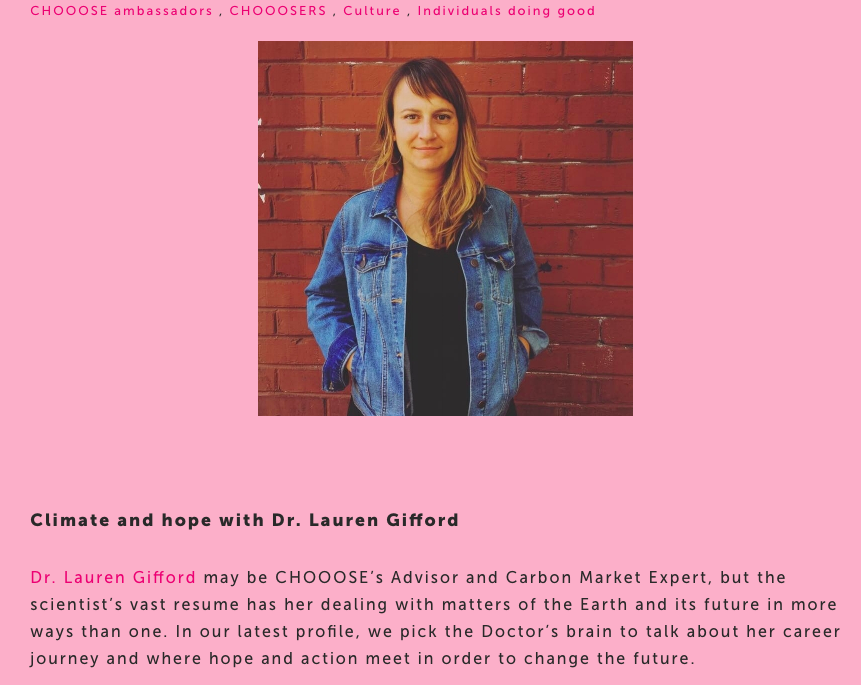
How did you first become interested in carbon markets and geography? Was it something that called to you as a child? Do you remember the specific moment you saw this as your calling, so to speak?
In 2007 I began working on issues related to climate justice. This was the point when carbon markets were really emerging as a tool for climate change mitigation. I learned that there is a lot going on behind the scenes in global climate action, and that many of the policies and financial mechanisms are so complex that most people don’t fully understand them. At that point, I decided I wanted to focus on these complexities.
*
There is a lot of climate anxiety out there that makes people paralyzed in action. Do you have hope for our planet? If so, how would you encourage others to keep their hopes up too?
If we don’t have hope, what do we have? But I also think relying on hope is ineffective and dangerous when it comes to addressing climate change. We must truly acknowledge and accept that climate change is an urgent, all-encompassing, catastrophic environmental shift that is already underway. It’s not a joke, and it’s not something we can reverse with just positive ideals. But we need to find a balance. Sure, be hopeful, but we still need to make some great structural and institutional shifts.”
*
What is your favorite aspect about what you do?
To be able to think deeply about complex issues is a real privilege. I feel it’s my responsibility to share my knowledge with others to help ensure climate change is addressed in ways that are both effective, and don’t harm frontline communities—the folks feeling the effects of climate change first and most acutely. Humans are all experiencing climate change differently, and it’s important that we recognize this unevenness and do what we can to amplify the plight of those experiencing the impacts of climate change already. I am humbled to be able to contribute to this mission.
Exploring the Multiple Subjectivities of Forest Carbon Offsets
I wrote a blog post detailing my dissertation research, subtitled “What IS a forest carbon offset, anyway?
Here’s an excerpt:
”My research examines the use of forest carbon offsets as a means of conservation finance, and looks at the complexity of linking forest conservation to financialized carbon storage. I question the shift of a mechanism often criticized for its neocolonial implications of north/south capital flows, to one re-imagined by US landholders, reconfigured to administratively meet their needs, often without real change to forest management practices.
My dissertation is based on five years of qualitative data collection on forest carbon projects in the US and Latin America—with a focus on two projects, one in Maine and the other in the Peruvian Amazon. Additional data was gathered via annual attendance at the United Nations climate negotiations, meetings of emissions trading and ecosystem services professional communities, and via participant observation in carbon accounting training courses through the Greenhouse Gas Management Institute. The latter was employed to critically study the techniques and discourses used by carbon accounting and verification professionals.
The results of this research are vast, and I will spend the next few months wading through empirical and theoretical questions to help frame these findings in ways that are useful to science and policy communities. I’ll begin by exploring the multiple subjectivities of forest carbon offsets, asking how they work to co-produce one another, and ultimately how they influence seemingly dispirit climate and conservation policies. In short, I’ll distill this data in order to return to (and answer) the simple question that drove me to chase this topic in the first place: “What is a forest carbon offset, anyway?””
You can read the full post on Prometheus: The Science Policy Blog:
http://ciresblogs.colorado.edu/prometheus/2017/09/06/exploring-the-multiple-subjectivities-of-forest-carbon-offsets/
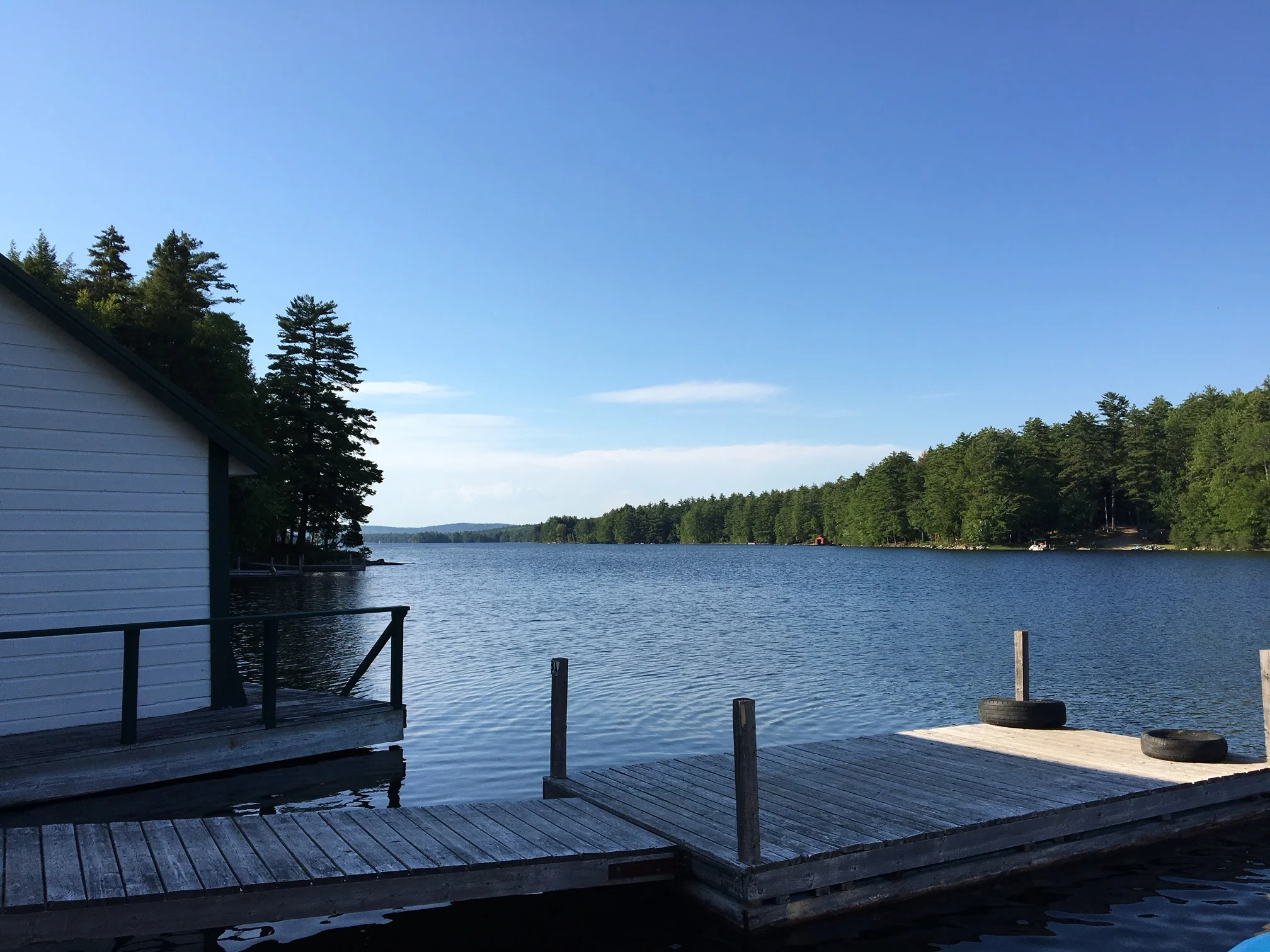
Grand Lake Stream, Maine. Home to the Farm Cove Community Forest, one of the most established forest carbon projects in the US. (Lauren Gifford photo)